
Motubrain 2.0: An Agentic World Action Model with
Aligned and Scaled Data


Overview
Motubrain 2.0 is an embodied intelligence system that combines the 20B-parameter Motubrain 2.0-WAM (World Action Model) with Motubrain-Harness, an editable agent orchestration framework. The WAM predicts future observations and generates actions from multiview images and instructions; the Harness plans tasks, calls tools, and adjusts the next step based on execution results. Building on a robot's ability to generate actions, we explore how it can autonomously complete complex, multistep tasks and continually improve through real execution.
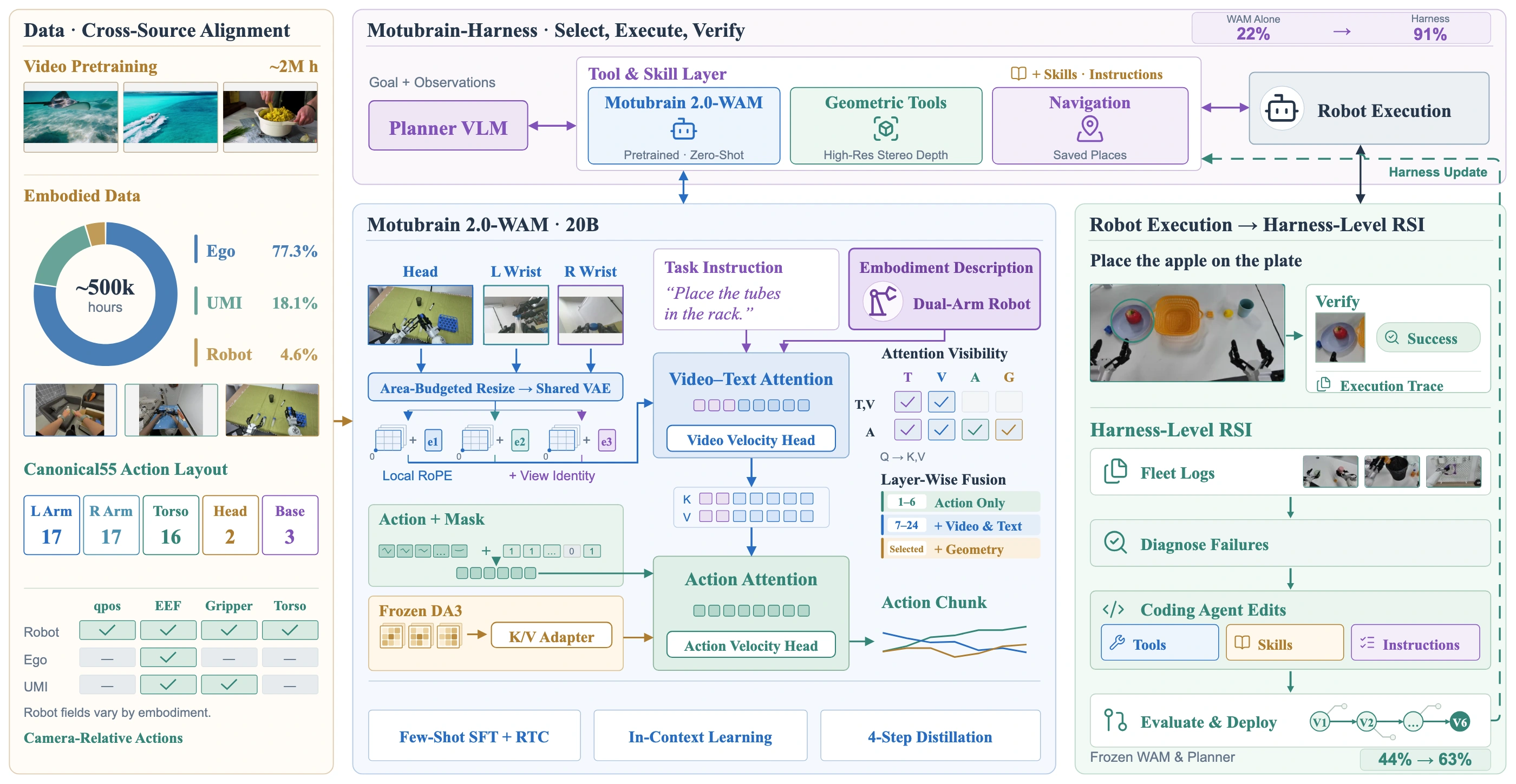
Building on the world-action generation capabilities demonstrated by Motubrain 1.0 (L3, World Action Models), Motubrain 2.0 explores the transition toward autonomous execution and continuous self-improvement (L4, Autonomous World Agents). This presents two main challenges: improving the Action Model's zero-shot generalization, 3D spatial perception, and real-time control across tasks, environments, and robot embodiments; and integrating those capabilities into an agent system that supports long-horizon planning, tool orchestration, skill learning, and autonomous improvement from feedback.
We address these challenges in two main ways:
- Aligning data from multiple sources to strengthen the foundation model. The 500,000 hours of embodied data used here cover human egocentric demonstrations, UMI data, and trajectories from multiple robot embodiments. A unified action representation, together with multiview images and 3D geometry, improves spatial perception and generalization across robots and tasks. Continued training on 19,000 strictly aligned human–robot pairs further develops Motubrain 2.0's embodied in-context learning (ICL) capabilities. With model parameters frozen, a single human demonstration video enables zero-shot execution of entirely new tasks, with flexible transfer across scenes and objects. We also introduce the 8.33B-parameter Motubrain 2.0-WAM Nano to explore two-stage, embodiment-native pretraining that starts with a video foundation and spans visual and action learning.
- From action generation to completing long-horizon tasks. Motubrain-Harness organizes a high-level VLM planner, a pretrained WAM, 21 embodied tools, and 15 skills into a closed-loop execution system. Subtasks whose instructions appeared in WAM pretraining are executed zero-shot by the WAM; the remaining subtasks are handled by geometric tools based on high-resolution stereo depth. Every step is visually verified, and the system automatically switches tools or revises its approach when the expected result is not achieved.
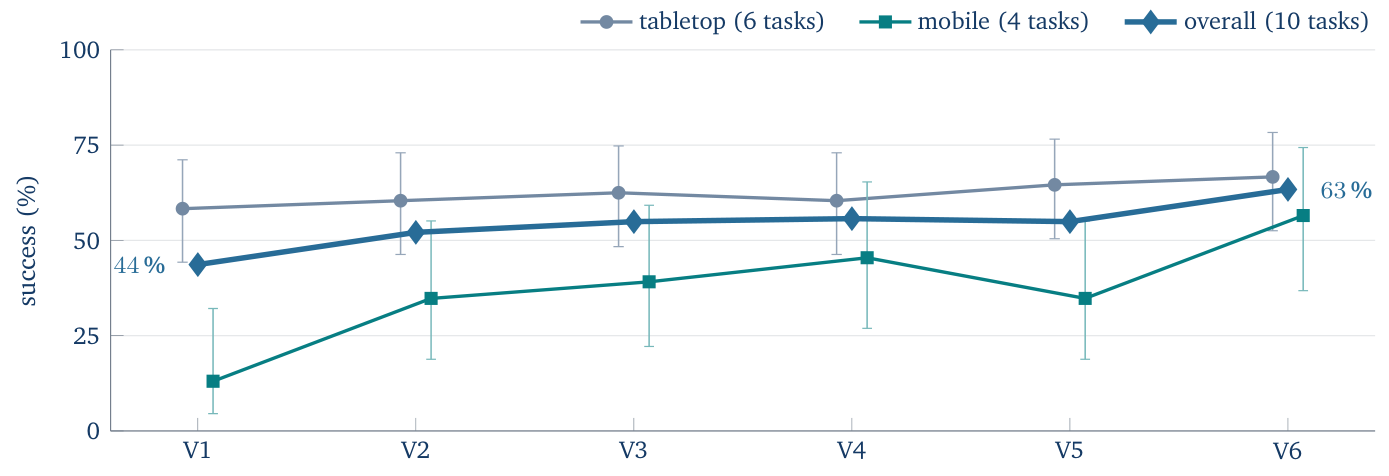
On this foundation, we explore recursive self-improvement (RSI) at the Harness layer. An agent analyzes Harness execution logs from multiple robots, identifies recurring causes of failure, and modifies skills, tools, and instructions before deploying the changes for validation on real robots. WAM weights and the high-level VLM planner remain unchanged throughout. Evolving skills: repeatedly validated tool usage and object manipulation strategies are recorded as reusable skill procedures, reducing time spent on unsuccessful attempts and improving the VLM's ability to use existing tools for physical-world tasks. Evolving tools: improvements to existing implementations and new tool code reduce redundant reasoning and tool calls while expanding the system's capacity for object perception and manipulation.
Motubrain 2.0 ranks first overall on four of six public simulation benchmarks and second on the other two. Real-robot comparisons also show that, with comparable exposure to target-robot data, adding aligned human egocentric data increases average zero-shot success across four tasks from 52.2% to 73.4%, with equal weighting per task. In a 20-day evaluation covering 13 robots, 18 household tasks, and 3,137 episodes, introducing the Harness raises success on tasks with seen instructions from 22% to 91%. With model weights unchanged, Harness self-improvement increases overall success on ten tasks from 44% to 63% and yields approximately four times as many successful mobile-manipulation trials.
Methods
Motubrain 2.0 learns how the physical world changes from video and how to control robots from manipulation trajectories. Different data sources provide different information: video alone can teach the model what happens next; when it also includes actions with clearly defined semantics that are synchronized with the images, it can support learning control.
We focus on four areas: aligning data from different sources, designing a model that supports both video prediction and action generation, scaling the training data, and using an agent to apply these capabilities to complex tasks.
1. Unified Representation and Alignment of Multisource Embodied Data
Datasets differ substantially in embodiment, camera viewpoints, and recording conventions. Egocentric, UMI, and multi-embodiment trajectory datasets use different coordinate systems, action formats, and sampling rates, and may have missing or inconsistent action labels. Before training, we apply a series of preprocessing steps to address these differences:
- Unifying action representations. To reconcile heterogeneous action spaces across embodiments and data sources, we use Canonical55 to map end-effector poses, gripper states, joint states, and related information into a 55-dimensional action vector. A validity mask indicates which dimensions are available for each sample. For example, 3D hand trajectories extracted from human video can contribute to training, while the missing robot-joint and gripper dimensions are masked out of the loss. Videos with no action labels are used only for video-prediction training.
- Aligning images, actions, and instructions semantically. We first standardize coordinate definitions and gripper opening/closing semantics across sources, then calibrate the temporal correspondence between image sequences and action trajectories. Language annotations are reorganized at three levels: complete tasks, subtasks, and atomic actions. Pretraining primarily uses subtask-level instructions so that the operation described in language matches the actions the model is predicting.
- Checking data quality at multiple levels. Quality checks operate on complete episodes, local segments, and individual timesteps. Entire episodes that fail quality requirements are discarded; long static or defective segments are excluded from sampling; missing or invalid action labels are masked out locally. This retains usable portions of a record while limiting the influence of incorrect labels on training.
- Processing source recordings into training data. The data system contains more than 34.66 million episodes. Preprocessing proceeds through several stages: verifying the integrity of recording timelines, unifying action formats and aligning modalities, filtering quality, deduplicating samples, and generating language annotations at three levels. After annotation, alignment and action boundaries are checked again, and action statistics are computed separately for each robot embodiment.
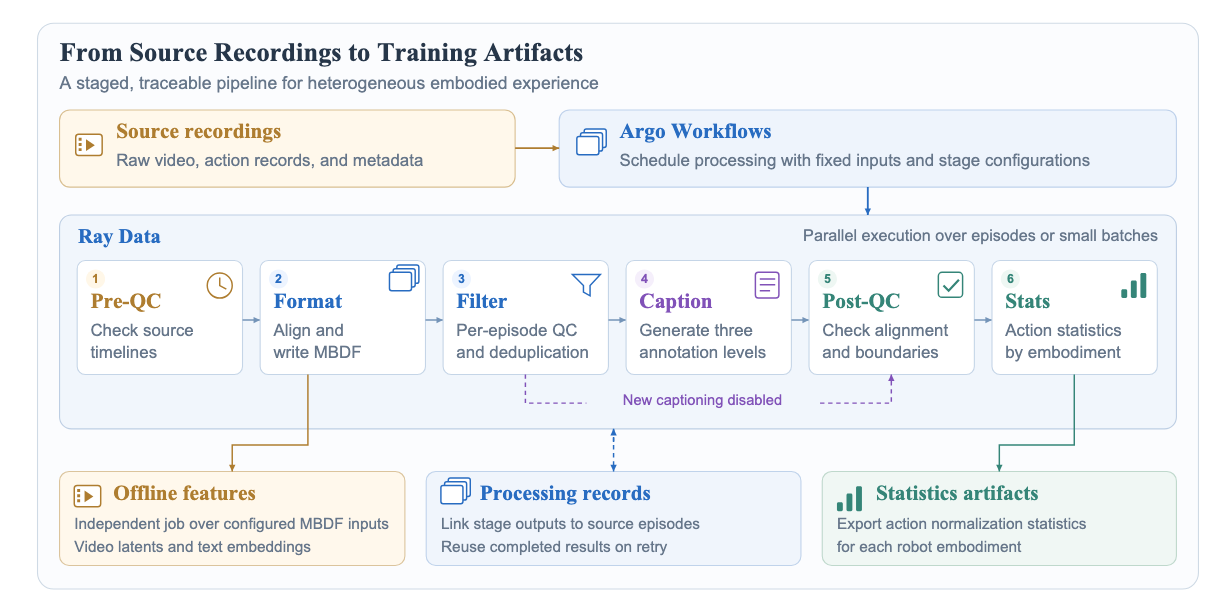
Argo Workflows orchestrates this pipeline, while Ray Data processes episodes or small batches in parallel. Video and text features are generated by independent offline jobs that can be scheduled separately. Each stage retains its inputs, configuration, and processing records, making it possible to reuse results, retry failed jobs, and trace how each record was processed and which training task ultimately used it.
2. Four-Stream Architecture and Multiview Spatial Perception
Once the data has been organized and aligned, the next question is how a single model can make effective use of video, language, actions, and 3D geometry.
Initialized from Vidu video-generation weights, Motubrain 2.0 uses a 20B-parameter, four-stream Transformer architecture to process text, video, actions, and 3D depth features. The depth features are extracted by a frozen Depth Anything 3 encoder. At each control step, the model jointly predicts future observations and actions from multiview RGB images and language instructions.
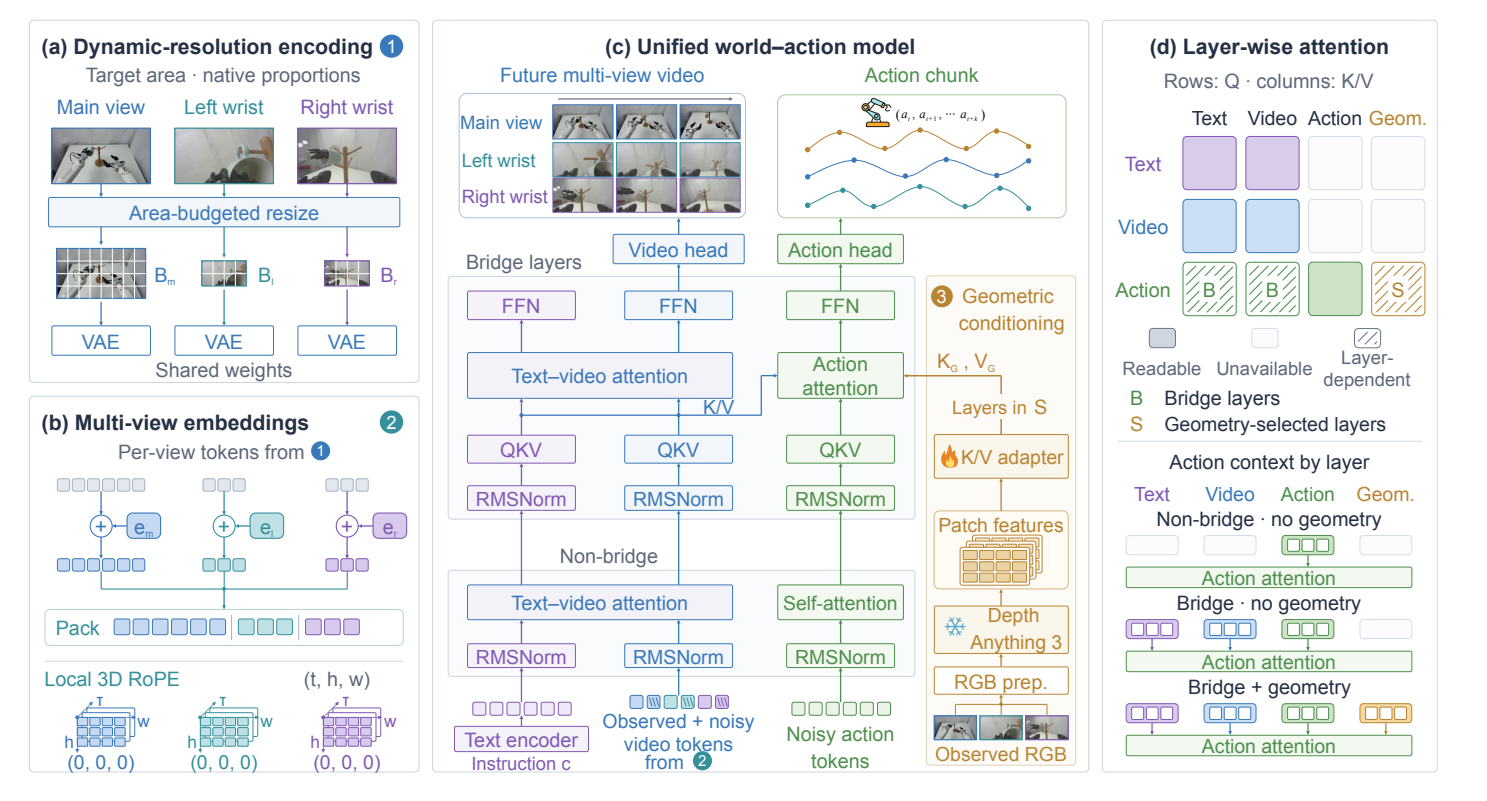
- Using the capabilities learned during video pretraining for action learning. Video pretraining provides rich visual and dynamic information. Asymmetric attention lets the action branch read video and language features while preventing video and language from reading actions or external geometry, reducing interference with pretrained video capabilities. This constrains the direction in which information is read; during joint training, action-loss gradients can still propagate through attention into video features. Video and actions sample noise timesteps separately, allowing action-only generation at deployment.
- Processing each camera view separately. Robots differ in camera count, aspect ratio, and resolution. We resize each view according to its pixel-area budget, apply the required alignment crops, and encode it separately, using view embeddings to distinguish cameras. Compared with stitching all views into a fixed canvas, this reduces image distortion and accommodates different camera configurations.
- Adding spatial information to action prediction. A frozen Depth Anything 3 (DA3) encoder extracts geometric features from current RGB observations and injects them into action-attention layers. This supplies 3D spatial information without requiring additional depth labels, camera extrinsics, or an extra depth-supervision loss.
3. Data Scaling and Mixed Pretraining
After data alignment, we ask whether human video, UMI demonstrations, and real-robot data can jointly improve robot capabilities, and how generalization changes as training continues.
Motubrain 2.0 uses approximately 2 million hours of internet video and 500,000 hours of embodied data, accounted for separately. The former supplies physical-dynamics priors for the video-generation backbone. The latter comprises approximately 34.66 million episodes: about 386,500 hours of human egocentric data, 90,200 hours of UMI data, and 23,000 hours of robot data.
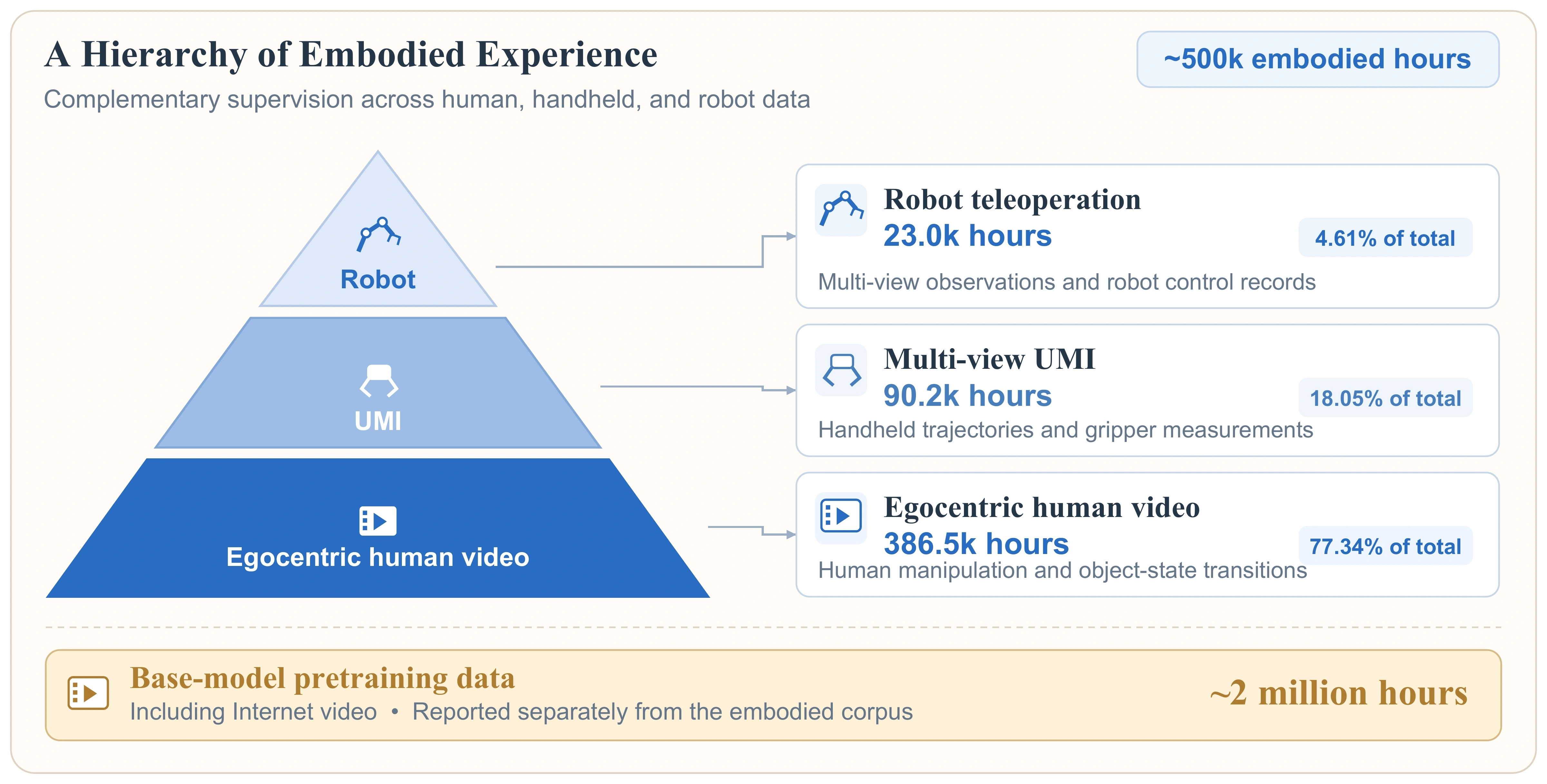
- Mixing data from different sources. Each training step samples from multiple sources. Video-only data teaches future-frame prediction; human egocentric, UMI, and robot data contribute to video prediction and action learning according to the labels actually available. Data loading and distributed training are designed to support this mixture.
- Using sampling strategies suited to each data type. For relatively scarce real-robot data, we sample uniformly within valid training windows to cover all stages of manipulation. For human egocentric and UMI data, a two-stage process selects an episode and then a segment within it. This prevents a few long videos from dominating training and increases diversity in scenes, objects, and operations.
- Testing whether human data helps robot manipulation. We conduct a controlled real-robot comparison in which both models omit the DA3 geometry branch, use the same backbone configuration, and have comparable training exposure to target-robot data. Adding aligned human egocentric data increases average zero-shot success across four tasks from 52.2% to 73.4% and average score from 75.3 to 83.8, with equal weighting per task. On headphone hanging, success rises from 35.0% to 80.0%. We also observe tool-use actions absent from robot teleoperation data, such as continuous cutting movements transferred from human cooking videos.
- Monitoring training effects over time. Longer training does not necessarily improve performance in every environment. Some later checkpoints remain stable under standard conditions but regress under lighting changes and visual distractions. One possible cause is an imbalance in how often different sources are revisited: smaller real-robot datasets are reused many times while more diverse human video remains underused. Scaling data therefore also requires adjusting sampling ratios and choosing checkpoints using real-robot performance under both standard and perturbed conditions.
We also introduce the 8.33B-parameter Motubrain 2.0-WAM Nano. It first learns visual interaction priors from scratch using internet videos and embodied manipulation videos filtered for physical continuity. It then undergoes joint video–action pretraining on approximately 370,000 hours of human egocentric, UMI, and multi-embodiment robot data, using unified action and multiview representations to turn these priors into manipulation capabilities.
4. Motubrain-Harness: From Action Generation to Long-Horizon Task Completion
Long-horizon household tasks require coordinated goal understanding, object localization, action selection, and movement between rooms, as well as timely recovery from failures. Motubrain-Harness integrates task planning, the WAM, geometric manipulation, and navigation into a closed-loop system, using real execution feedback to improve the system itself.
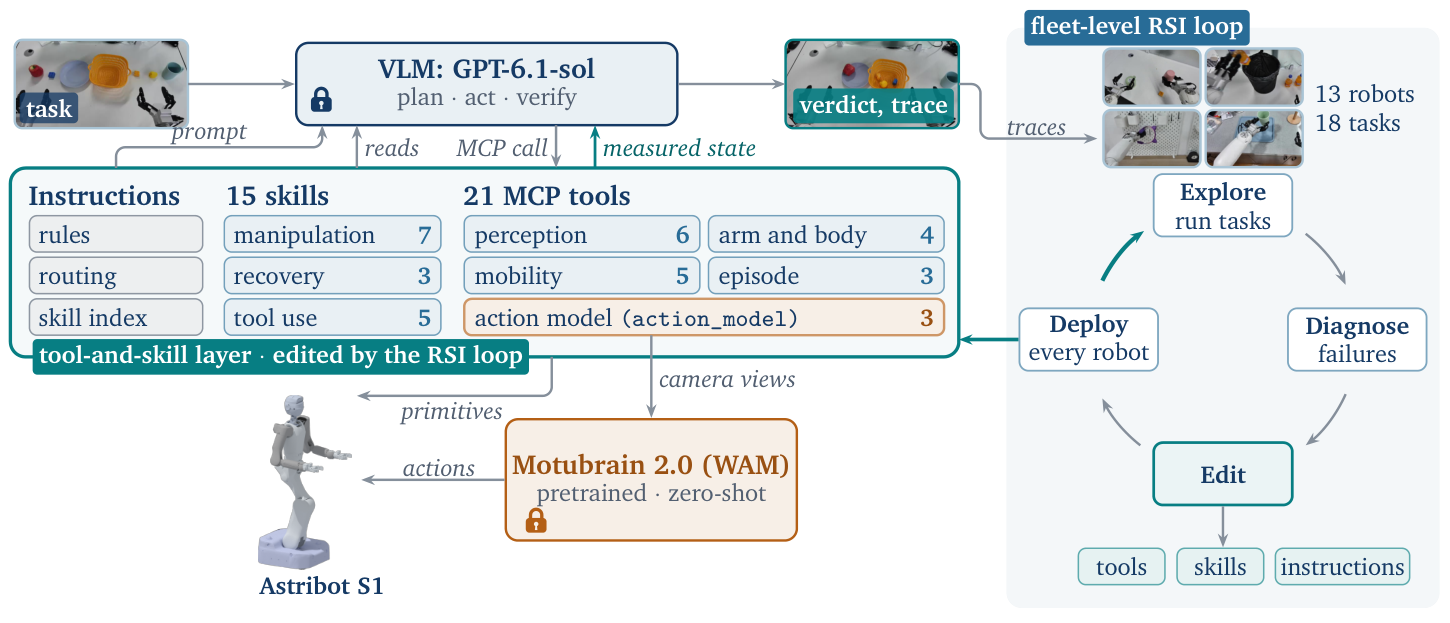
- Task decomposition and tool routing. The high-level planner breaks a task into steps using the goal and current observations, then chooses how to execute each step. Subtasks whose instructions appeared in WAM pretraining and that require compliant contact are assigned to the WAM. Unseen objects, small objects, precise placement, or stalled WAM execution are handled by geometric tools. Navigation tools handle movement between rooms.
- 3D localization of millimeter-scale objects. Geometric tools rely on Pixel-to-3D perception from a high-resolution stereo-depth estimation model. In a test with 14 tabletop candies approximately 11 mm tall, neither sensor depth nor conventional stereo could distinguish them from the table. The high-resolution model distinguished all 14; the faster deployed version distinguished 12.
- Visual verification after every step. After each operation, the agent acquires new images and checks whether the expected result occurred. If not, it revises instructions, switches tools, or selects another action plan. Every tool call, its observations, and its outcome are recorded in full to support subsequent improvement.
- Self-improvement from execution feedback. A coding agent analyzes fleet execution logs, assigns each failed episode to a failure category, and uses the diagnosis to modify tool implementations, skill procedures, and instructions before deployment and validation. WAM weights and the high-level planning model remain unchanged. Of 722 diagnosed issues, 720 occurred on at least two robots. Changes therefore target shared tools, skills, and instructions, so a single fix can be deployed across the fleet.
Experiments
We evaluate Motubrain 2.0 at three levels: whether the foundation model can manipulate objects in different environments, whether a few demonstrations or a reference video can help it adapt to new tasks, and whether adding the Harness enables more reliable completion of long-horizon goals.
5. Evaluation on Six Simulation Benchmarks
Results on multiple public benchmarks demonstrate strong performance in robot manipulation. To assess the model's own capabilities, none of the following six evaluations uses a high-level VLM agent. The benchmarks cover complex subtask combinations in long-horizon household work, bimanual coordination, mobile manipulation, and fine manipulation, while also testing generalization to environmental changes and new scenes. Because tasks, training configurations, and scoring methods differ, we report each benchmark separately.
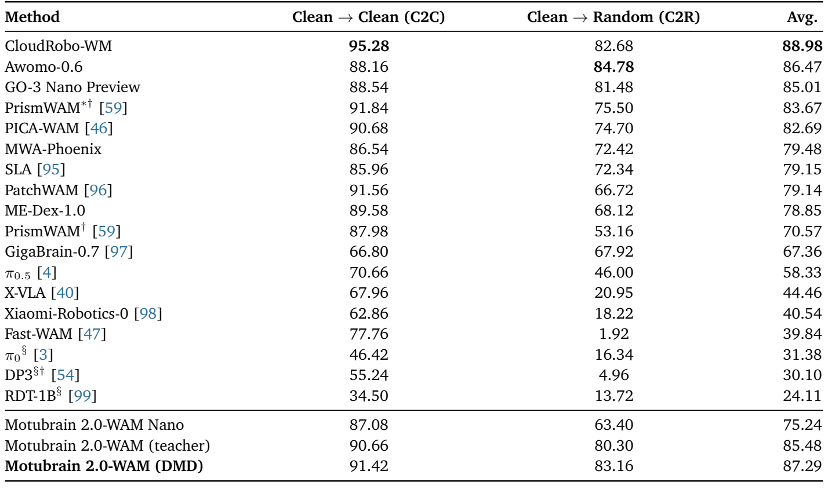
On RoboTwin 2.0, Clean→Clean tests execution under standard conditions, while Clean→Random introduces random changes at test time to evaluate adaptability. Motubrain 2.0 achieves success rates of 91.42% and 83.16%, respectively, for an average of 87.29%.
The other five benchmarks give the following results:
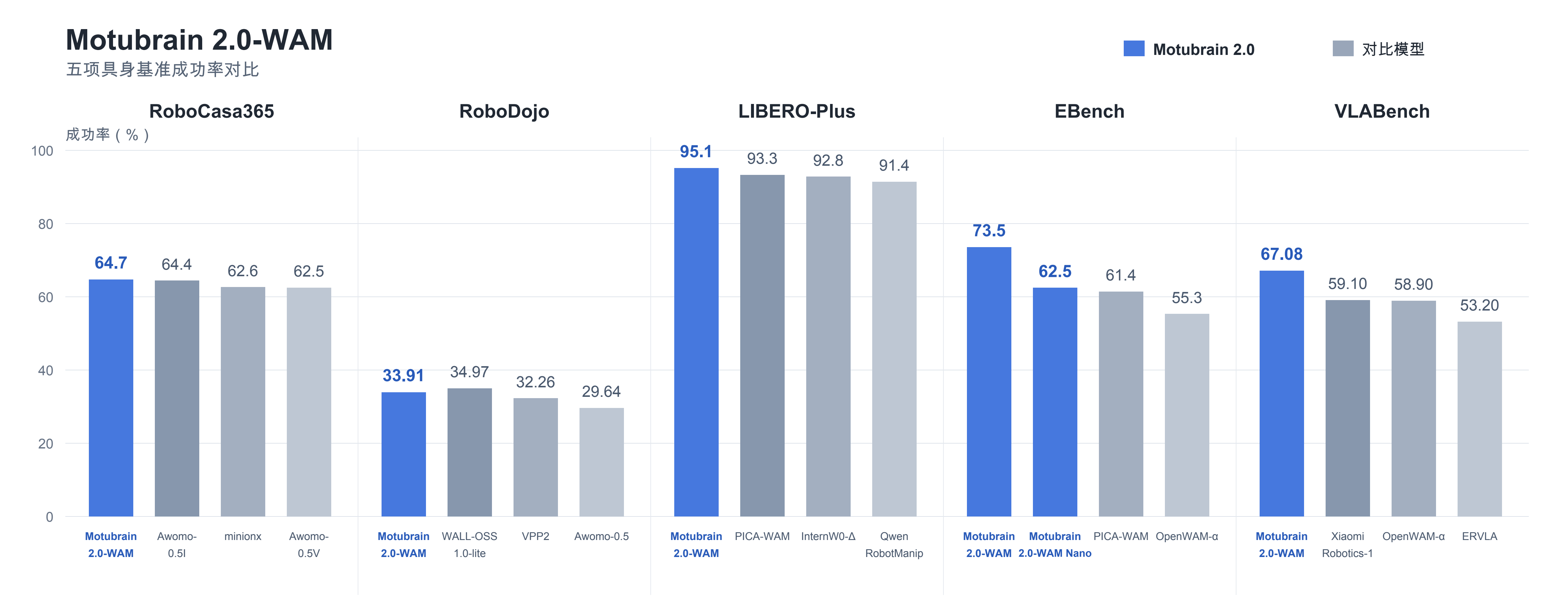
- RoboCasa365: 64.7% success rate.
- RoboDojo: 33.91% success rate and a score of 41.28.
- LIBERO-Plus: 95.1% success rate.
- EBench: Motubrain 2.0-WAM achieves a 73.5% success rate and a score of 83.5; Motubrain 2.0-WAM Nano achieves a 62.5% success rate and a score of 76.2.
- VLABench: 67.08% success rate.
6. Few-Shot Real-Robot Adaptation
The previous section showed Motubrain 2.0's strong simulation results. Can it also perform well on different real robots with only a small number of demonstrations?
We test Astribot S1 and AgileX PiPER on seven robot–task combinations spanning five task categories, completing 2,300 valid real-robot trials.
Each task poses a different challenge. Chopstick insertion requires a precise grasp followed by alignment and insertion. Cup hanging tests spatial perception of the cup handle relative to the hook. Bottle opening and pouring is a long-horizon task requiring a sequence of fine actions, from unscrewing the cap to holding and pouring from the bottle. Conveyor sorting is dynamic: objects keep moving, so the robot must time its grasp and sort them correctly. Ordered block stacking tests semantic understanding—the robot must interpret the instruction and determine which block comes first and which comes next.
Every experiment uses both Clean and Random conditions. Clean resembles the demonstration-collection environment. Random changes the lighting in all five task categories, changes the tablecloth background in the four tabletop tasks, and uses out-of-distribution (OOD) items for conveyor sorting. All real-robot tasks use real-time chunking (Training-RTC): while the robot executes the current action chunk, the model computes the next one, reducing pauses for inference and making transitions smoother.
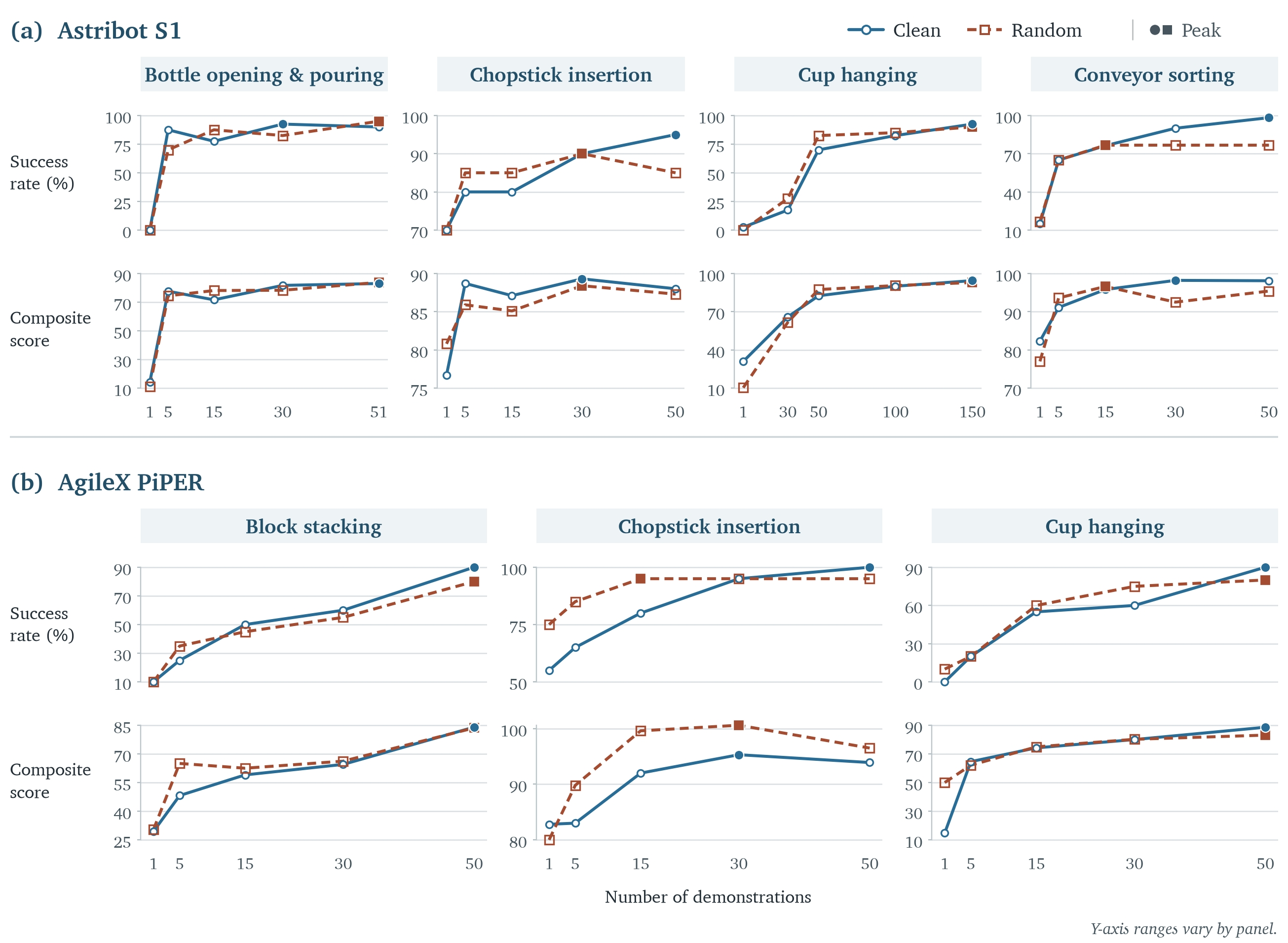
Figure 7 shows performance on both robots across demonstration counts. Four findings summarize the results:
- Some tasks improve with only a few demonstrations. With just one demonstration, Astribot S1 reaches 70% success on chopstick insertion under both Clean and Random conditions; PiPER reaches 55% and 75%, respectively. Bottle opening and pouring requires bimanual coordination across unscrewing, pouring, and raising a cup. With one demonstration, Astribot S1 completes none of the 40 Clean trials end to end, although partial progress is visible. With five demonstrations, it completes 35 of 40 trials, reaching 87.5% success.
- For most tasks, no more than 50 demonstrations brings Clean success to 90% or above. Six of the seven robot–task combinations reach this level. With 50 demonstrations for post-training, PiPER achieves 100% Clean success on chopstick insertion and 90% on both cup hanging and ordered block stacking.
- Overall performance remains close to Clean levels after changes to the test environment. With 30 demonstrations, average success across the seven task combinations is 72.1% under Clean and 71.7% under Random, a difference of less than one percentage point. For chopstick insertion, changing the lighting and covering the table with a black cloth leaves both S1 and PiPER at their Clean success rates of 90% and 95%, respectively. Environmental changes do not affect every task equally, however; the gap is more pronounced for conveyor sorting.
- Dynamic tasks can also be handled successfully. Objects on a conveyor keep moving while inference runs. Training-RTC lets the robot execute the current actions while computing those that follow. With 50 demonstrations, Astribot S1 correctly sorts all five objects in 59 of 60 Clean rounds, a whole-round success rate of 98.3%. With changed lighting and objects unseen during training, it still completes all five in 46 rounds, achieving 76.7% whole-round success and an average of 4.77 correctly sorted objects per round.
7. Reference-Video-Driven Task Transfer
In real-world manipulation, language instructions often struggle to specify the order of multistep operations, spatial constraints, and fine action details. A human demonstration video can show directly how to perform a task. Building on Motubrain 2.0, we therefore explore embodied in-context learning (ICL) through Entangle (see the paper). With model parameters fixed and no task-specific fine-tuning, a single human demonstration video can guide a robot through a task unseen during training, following the demonstrated order and action details.
Extending human-video ICL to world-action models (WAMs) faces two main obstacles: a lack of frame-aligned data, and a tendency for models to infer the task from its first frame. We address these through data construction and training:
- Scaling aligned synthetic data with video generation. Earlier human–robot pairs were often aligned only at the task level; their timing and trajectories differed, leaving the model to treat the reference video as a coarse task label. We use video editing to replace robot arms in existing trajectories with human hands, expanding frame-aligned synthetic data at low cost and building a dataset of 21.3k strictly aligned pairs.
- Preventing shortcuts with contrastive learning and dynamic replanning. When a task has multiple valid solutions, a model can infer the intended task from the initial scene and ignore the demonstration. We introduce within-task contrastive learning (InfoNCE), together with variable-window training and time-offset positional encoding, to encourage close tracking of the demonstrated actions. During inference, Adaptive Horizon truncates execution and replans as soon as the model's attention to the reference video weakens, limiting long-horizon error accumulation.
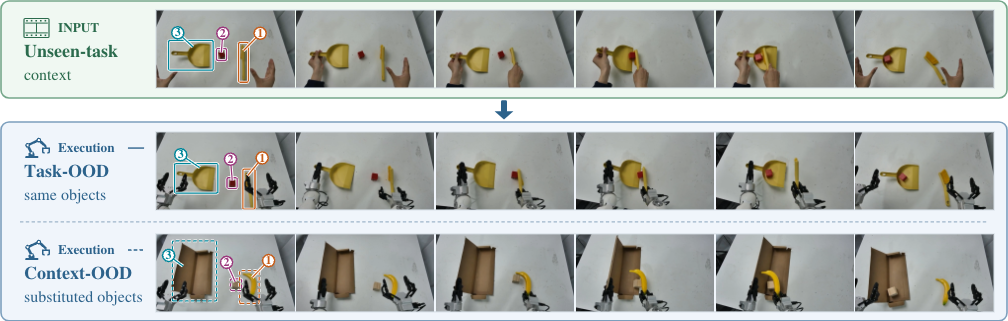
Experiments examine two types of transfer, illustrated in Figure 8:
- Task out-of-distribution (Task-OOD) tests: Can the robot complete goals and procedures unseen during training? Test tasks are excluded from both Motubrain pretraining and continued ICL pretraining.
- Context out-of-distribution (Context-OOD) tests: Object positions or manipulation tools are changed relative to the reference video to test whether the robot can still follow the demonstrated procedure.
Across seven RoboTwin tasks excluded from training, evaluation with three random seeds yields an average success rate of (69.52 ± 0.64)% (mean ± standard deviation), exceeding Zero-WAM's reported result by 22.57 percentage points. On six unseen real-robot tasks using S1, every task and configuration is evaluated 10 times, with an average task score of 83.5/100.
Context-OOD tests reveal generalization across scenes and objects: the model adapts to changes in object arrangement, substitutions within an object category, and transfers of tool function across categories. Real-robot tests further show zero-shot execution of new tasks from demonstration videos generated directly by a video model. This allows a video-generation model to act as a zero-shot visual planner, enabling new robot skills without a live human demonstration.
8. Real-Robot Evaluation: Harness Improves Task Completion and Continually Self-Improves
Agent evaluation covers 13 robots, 18 household tasks, and 3,137 counted episodes over 20 days. We ask how much planning, tool use, and result verification improve performance, and whether modifying tools and skills based on execution feedback can deliver further gains.
- Approximately four times the task success rate. On four tasks with seen instructions, the full agent succeeds in 29/32 trials, compared with 7/32 for the standalone WAM. Their capabilities are complementary: the Harness succeeds in 25/32 trials without calling the WAM and 29/32 when it does.
- The skill library is a major source of improvement. Removing all 15 skills reduces tabletop task success from 67% to 21%.
- Continued improvement with model weights fixed. On the same ten-task suite, iterations from Harness V1 to V6 increase overall success from 31/71 (44%) to 45/71 (63%). Successful mobile-manipulation trials rise from 3/23 to 13/23.
Conclusions
From data alignment and model training to real-robot execution, Motubrain 2.0 explores how robots can apply learned manipulation capabilities to complex tasks. The 20B WAM supplies foundational manipulation capabilities, Nano further explores embodiment-native pretraining from a video foundation through action learning, and the editable Harness organizes planning, tools, and execution feedback. Six public simulation benchmarks, standardized real-robot tests, and weeks of agent deployment help us evaluate the approach and identify unresolved challenges.
- Scaling data starts with getting alignment right. Data from different sources can support joint training more effectively when action semantics, coordinate conventions, and label handling are consistent.
- There is more than one way to adapt to new tasks. In the fine-tuning setting, a few task demonstrations and lightweight training transfer pretrained capabilities to new tasks and scenes, achieving high success in fine manipulation, multistage operations, and dynamic sorting. In the in-context learning setting, ICL-WAM transfers demonstrated procedures to target tasks using reference videos without updating policy weights, with effectiveness demonstrated on multiple RoboTwin and S1 tasks. Together, these approaches span few-shot parameter adaptation and context-based transfer without parameter updates, helping reduce the cost of demonstration collection and training for new tasks.
- Task completion can continue improving without updating model weights. For tasks with seen instructions, adding the Harness raises success from approximately 22% to 91%. Across six versions of self-improvement, success on ten tasks rises from 44% to 63%. These gains come from changes to tools, skills, and instructions, without retraining the WAM. Because most issues recur on multiple robots, one fix can be deployed across the fleet.
- Continuous evaluation is equally important. A model that remains stable under standard conditions can still regress under lighting changes and visual distractions. We also plan to release 1,000 hours of Astribot S1 real-robot demonstrations, and the report provides entry points to code and model resources.
As task planning and depth perception become more reliable, much of the remaining performance gap lies in the details of contact-rich manipulation. Next, we will use execution experience collected by the Harness to improve the WAM itself. For example, trajectories of successful actions, geometric-tool takeovers, and failure recovery can become post-training and reinforcement-learning data, gradually turning behaviors that currently require multiple tool calls into faster action skills. Reducing planning latency, supporting dexterous hands with more degrees of freedom, and sharing experience across different robot types are further directions we will explore.